


Elements Of Physical Chemistry
Publisher: MacMillan
Format: Hardback
ISBN: none
Elements of Physical Chemistry (1961)
By Samuel Glasstone & David Lewis | Macmillan
ISBN: none (back when molecules had quantum numbers but books didn’t)
Condition: Good as sold by Crappy Old Books
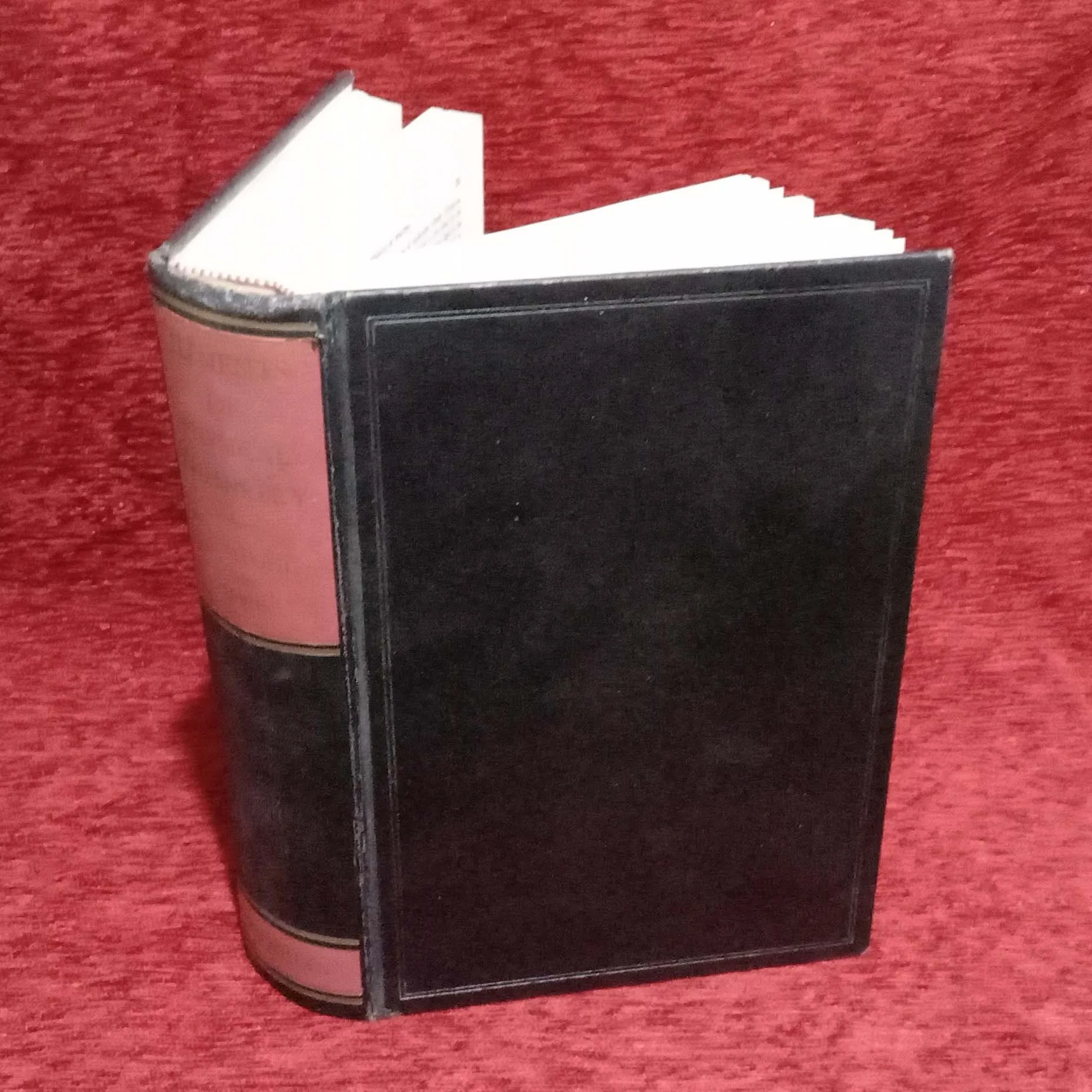
Behold: physical chemistry, in its natural 1961 habitat—bound in sober black boards, with pink title panels that look faintly embarrassed about how hard the maths is.
This is Glasstone & Lewis, the classic mid-20th-century attempt to explain why:
-
gases sulk,
-
solutions misbehave,
-
reactions take their time,
-
and everything in the universe insists on following the laws of thermodynamics even when it’s deeply inconvenient for your experimental results.
What’s inside (besides tiny symbols and looming exams)
You get the full foundational tour:
-
Thermodynamics – enthalpy, entropy, free energy and the dawning realisation that spontaneity isn’t about personality, it’s about ΔG.
-
Chemical equilibrium – who goes where, how much, and why your system refuses to cooperate with your intuitions.
-
Kinetics – rate laws, mechanisms, and the crushing truth that doubling the concentration does not always mean doubling the speed.
-
Electrochemistry – cells, potentials, and the noble art of making electrons walk in an orderly fashion.
-
Possibly a polite introduction to quantum theory – just enough to terrify you with wavefunctions before sending you back to partition functions.
All delivered in that impeccable early-60s textbook voice:
“Consider a perfectly idealised system…”
No one has ever met such a system, but it marks its presence on every page.
The tone: stern, clear, quietly proud
Glasstone & Lewis write as if:
-
You are serious,
-
You have paper, pencil and time,
-
And you’re willing to suffer a bit for understanding.
There are:
-
Diagrams that actually help
-
Worked examples that start simple and creep up on you
-
Problem sets that say, in effect, “So you thought you understood equilibrium constants, did you?”
Yet it’s strangely reassuring. There’s a sense that the universe, while complicated, is at least consistent—unlike your lab partner.
This particular copy
From the photo:
-
Black cloth boards with blind-ruled borders and contrasting pink spine panels—full “serious reference book in a 1960s faculty office” aesthetic.
-
Condition: Good – in Crappy Old Books terms:
-
Binding solid, hinges fine, no pages attempting spontaneous fission.
-
Spine ends and corners a bit rubbed from travelling between lectures, labs and late-night revision sessions.
-
A few small scuffs to the boards—cosmetic, not structural; think of them as surface defects with negligible effect on bulk properties.
-
Inside you can reasonably expect:
-
Clean, legible text;
-
Light page-toning appropriate to its age;
-
Possibly the odd pencilled formula or half-erased panic note from a long-graduated student.
Nothing to stop you working through the chapters—only your courage.
Why you might actually want this
-
You love old scientific textbooks that explain things without cartoons, colour gradients or marketing departments.
-
You’re studying chem and want to see how your grandparents were terrorised into learning the same material.
-
You like thermodynamics and kinetics served straight, with no modern hand-waving: just definitions, derivations, examples.
-
You’re the sort of person who enjoys leaving a heavy, respectable book on your desk so people assume you are much more intelligent (and perhaps more dangerous) than you let on.
It’s also weirdly useful as a reference: the numbers haven’t changed, and the laws of thermodynamics remain stubbornly in force.
The vibe
Reading Elements of Physical Chemistry feels like:
-
Sitting in a chilly lecture theatre while a very precise professor fills the board with equations that, to your surprise, eventually make sense.
-
Realising that concepts that once felt mystical—activity coefficients, rate constants, equilibrium—are actually just grumpy but understandable.
-
Getting that rare “aha” moment when a horrible diagram suddenly becomes obvious… followed immediately by a new, slightly worse diagram.
It’s not a light read, but it will make you feel like you’ve wrestled something big and abstract into submission, at least for a bit.
Condition vs. Activation Energy
-
Physically: Good – robust enough to survive repeated consultations, margin notes, and the occasional despair-driven thump onto the desk.
-
Intellectually: still a solid activation barrier between you and hand-wavy chemistry. Cross it, and you’re in the land of real understanding.
Offered by Crappy Old Books, where the bindings are black, the spine labels are pink, the condition is Good, and the entropy is always increasing—except, temporarily, in your well-ordered study notes.
Keep browsing: See more Academic books Other books by Sqamuel Glasstone and David Lewis
